SOLDAR: Supporting Low-Volume PCB Prototyping Using Collaborative Robots and Augmented Reality
Abstract
Printed circuit boards (PCBs) are fundamental to modern electronics and are present in almost every electronic device. However, despite their ubiquity, current PCB assembly methods can be time-consuming and lack flexibility for one-off designs. This poster investigates how low-volume PCB prototyping can be enhanced by integrating collaborative robots (cobots) and Augmented Reality (AR). Specifically, we introduce SOLDAR, a system that facilitates the soldering of electronic through-hole components on PCBs. By using a cobot for optimal PCB positioning and AR glasses for step-by-step guidance, SOLDAR aims to streamline the assembly process. The expected outcomes are increased efficiency, reduced assembly time, and greater flexibility for low-volume PCB prototyping designs. To validate these hypotheses, user experiments are necessary.
CCS Concepts
- Computing methodologies~Mixed / augmented reality
- Hardware~PCB design and layout
- Computer systems organization~Robotics
1 Introduction
Low-volume production, particularly in the context of PCB assembly, involves several challenges as discussed by Hodges et al. [1]. A key challenge lies in the placement and soldering of electronic components on PCBs. This assembly process typically relies on pick-and-place robots or assembly line cobots, which, despite their efficiency and precision, demand thorough configuration and calibration to manage small electronic components. Furthermore, these automated systems often involve intricate and bulky machinery, leading to substantial overhead costs when used for low-volume, rapid PCB prototyping.
As such, DIY enthusiasts and electronics engineers frequently turn to manual soldering workflows. These workflows are particularly relevant when using through-hole technology (THT) components. THT involves inserting components with leads (or "legs") into pre-drilled holes on the PCB, which provides strong mechanical connections and makes it easier to handle and test components during the prototyping process. The larger size and more robust nature of THT components make them more forgiving and accessible for manual assembly, especially when frequent adjustments are necessary. In contrast, surface-mount technology (SMT) involves placing components directly onto the surface of the PCB without the need for through-holes.
A significant challenge in manually soldering PCBs using THT is the lack of a "third hand". Soldering requires holding the PCB steady while simultaneously applying solder and using the soldering iron to heat the pad and lead. Without extra support, this can lead to misalignment or poor solder joints. Mechanical "helping hands" can assist, but they often need frequent adjustments, adding time and complexity to the process. Additionally, the leads of previously soldered components can get in the way, making it even more difficult to maneuver the soldering iron and apply solder accurately.
In this poster, we introduce SOLDAR, a system designed to enhance the soldering process for low-volume PCB prototyping by integrating collaborative robots (cobots) and augmented reality (AR) into the workflow. Our primary goals are to accelerate the prototyping process by reducing the overhead associated with calibration and configuration and to minimize the occurrence of errors. SOLDAR facilitates human-robot collaboration in the soldering of PCB components. The system features a robot that precisely moves and rotates the PCB to ensure optimal positioning for assembly and soldering, while an AR system guides the user through each step of the process. By leveraging component positions exported directly from PCB design software, SOLDAR optimizes the soldering sequence and calculates the most effective angles for PCB positioning. This approach helps to avoid interference between the soldering iron and through-hole components. Additionally, AR glasses provide real-time, in-situ guidance, ensuring correct component placement and adherence to the optimal soldering sequence.
2 Background
SOLDAR builds on the work of Van Den Bergh et al. [2] on collaborative 3D object assembly using cobots, which involves modeling objects and sequencing assembly through software. We adapt their approach to the domain of soldering, with a focus on precise PCB positioning rather than component placement. Bauer et al. [3] utilized AR to guide the positioning and rotation of parts on PCBs, dividing the assembly process into sections and validating parts for quality control. Similarly, our approach employs AR for precise placement and rotation of soldered components.
3 Proposed System
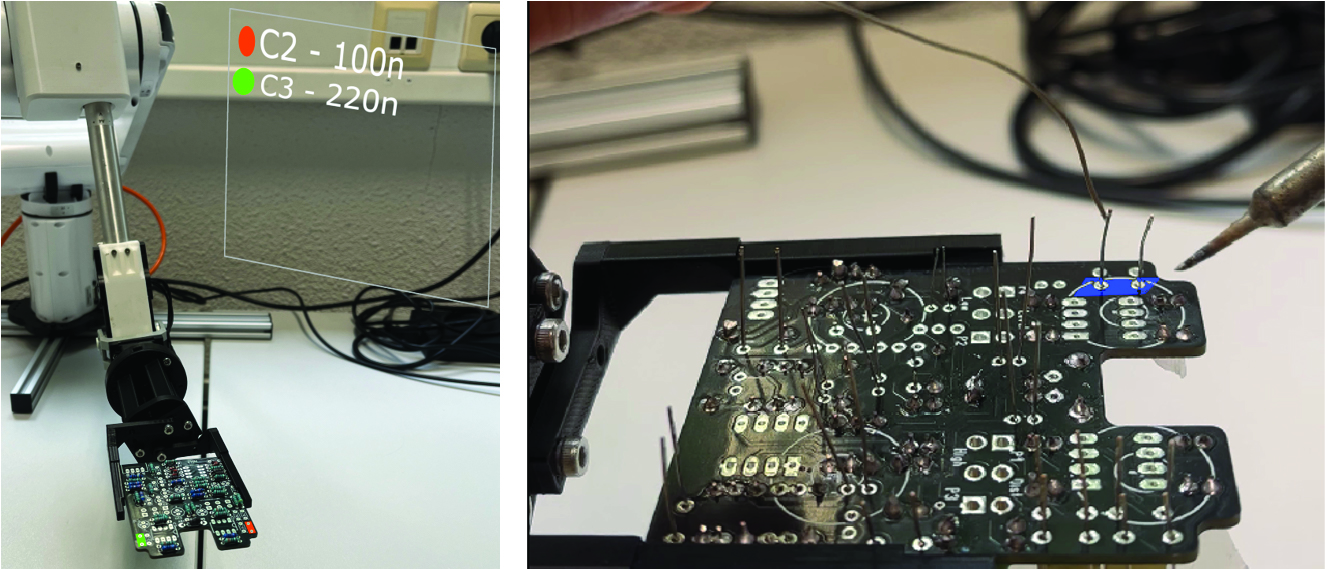
During PCB assembly, as illustrated in Figure 1 (left), the Magic Leap 2 (ML2) AR glasses guide users through step-by-step instructions for component placement and orientation. The system utilizes arUco markers to ensure precise alignment of virtual overlays on the physical PCB. We used the Mover6 cobot for the placement and orientation of the PCBs.
The optimal soldering angles are determined through software simulation made in Unity. This simulation evaluates multiple soldering angles around each component lead at a 45º inclination, mimicking a typical soldering posture. The algorithm calculates all potential interferences and selects the midpoint of the widest range of consecutive, interference-free angles as the optimal soldering angle. This ensures soldering can be performed without obstructions from nearby components. To further minimize interference with already positioned components, SOLDAR prioritizes smaller components in the soldering sequence. This strategy helps to overcome the challenges of soldering smaller parts when they are surrounded by larger components.
During the soldering process (Figure 1 (right)), the AR system guides the user by highlighting the component that needs to be soldered next, ensuring that the PCB is positioned at the optimal angle for soldering the component. The system uses arUco markers to maintain accurate alignment between the virtual overlays and the physical PCB, providing clear, real-time instructions on where to solder. The cobot positions the PCB to start at an accessible angle, and as each solder is soldered, the user confirms their progress. The system then adjusts the PCB’s position incrementally, bringing the next component into an ideal soldering position, and continues this sequence until all components are properly soldered.
4 Discussion and Conclusion
The proof-of-concept implementation of SOLDAR for PCB prototyping revealed several technical challenges. Our observations indicated that inaccuracies in displaying component positions were due to issues with data conversion and tracking errors in the ML2. Additionally, the PCB rotation mechanism often caused the board to shift, complicating the soldering process. Display inaccuracies further impaired effective user feedback and made close-up soldering tasks more challenging, particularly due to the ML2 glasses’ near-boundary limit of 25 cm. Addressing these issues will be crucial for improving the system’s overall performance. Future research should focus on enhancing tracking accuracy and developing more robust calibration methods to reduce these errors and improve the reliability of AR guidance in this context.
In conclusion, SOLDAR demonstrates the feasibility of using cobots and AR glasses to aid in soldering for low-volume PCB prototyping. While promising, the system requires further development and user testing to fully assess its impact and effectiveness.
Acknowledgments
This work was funded by the Flemish Government under the "Onderzoeksprogramma Artificiële Intelligentie (AI) Vlaanderen" program and by the Special Research Fund (BOF) of Hasselt University, BOF23OWB29. The infrastructure for this work is funded by the European Union – NextGenerationEU project MAXVR-INFRA and the Flemish government.
References
- Steve Hodges and Nicholas Chen. 2019. Long tail hardware: Turning device concepts into viable low volume products. IEEE Pervasive Computing 18, 4 (2019), 51–59.
- Jan Van den Bergh, Bram van Deurzen, Tom Veuskens, Raf Ramakers, and Kris Luyten. 2019. Towards Tool-Support for Robot-Assisted Product Creation in Fab Labs. In Human-Centered Software Engineering. Springer International Publishing, Cham, 219–230.
- Rudieri Dietrich Bauer, Salvador Sergi Agati, Marcelo da Silva Hounsell, and Andre Tavares da Silva. 2020. Manual PCB assembly using augmented reality towards total quality. In 2020 22nd Symposium on Virtual and Augmented Reality (SVR). IEEE, Los Alamitos, CA, USA, 189–198.